
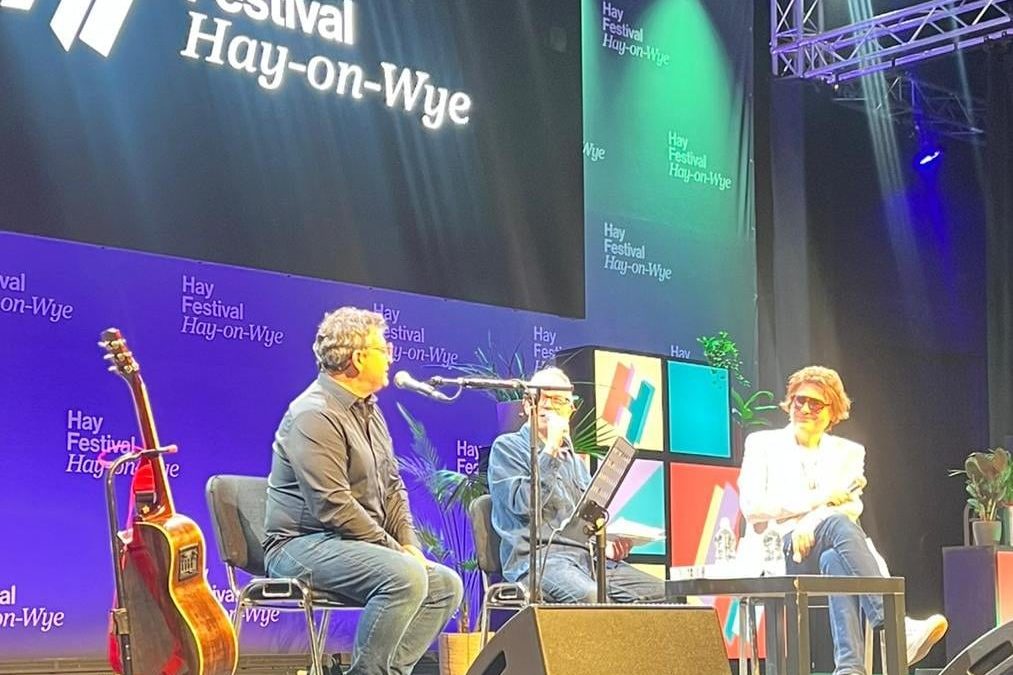
Credit: Ian Morris
The Manic Street Preachers struggled for many years to gain mainstream success.
However, when huge record sales and Brit Awards arrived so too did changes to personalities.
“I became a massive pain in the arse,” Nicky Wire admitted at the Hay Festival last night.
He blamed walking out on a Belgian festival on missing home while he said he couldn’t recall accusing bandmate James Dean Bradfield of over-the-top TV performances during their 90s heyday.
“You accused me of ‘acting singing’ and throwing my arms around,” claimed Bradfield.
Wire admitted that his love for South Wales was so great that he could have ‘lived at his mum and dad’s house forever’ – and that global travel had taken its toll.
Bradfield and Wire started the Manics with their childhood friends Sean Moore and Richy Edwards in the 1980s.
They spoke with a fondness for their early days when they slept in vans and even on a school gym floor in Redditch.
Mainstream success came when – in Wire’s words – they reacted to the fake representation of working-class Britain presented by ‘Parklife’ and ‘On the Buses’.
“I was trying to reclaim the seriousness of our lives,” Wire told the audience.
Fame took them to many places which included one trip to Cuba to launch their sixth studio album Know Your Enemy.
But, with this, came more challenging moments as a six-day trip with one single show saw the band peppered with questions on the way the Castro regime treated certain sections of society.
Bradfield also explained how he was left with only 20 minutes to rehearse their highly politicised song, Baby Elián, after repeated requests were made by the Cubans for the number to be added to the setlist.
Bradfield and Wire were joined on stage by Keith Cameron who has recently written a book called 168 Songs of Hatred & Failure: A History of Manic Street Preachers.
Many of the band’s early songs featured lyrics written by Edwards and Wire told the audience of his friend’s great work ethic.
He added: “When I read the honesty, purity and intelligence, I just wish he was still here. It was an amazing thrill to read Richy’s lyrics.”
Talking of the present, Bradfield lamented what he saw as a loss of support, respect and admiration for music in Britain today.
The conversations were interspersed with moving acoustic performances by Bradfield and showed the beauty of what can be achieved when creativity, skill and dedication is allowed to flourish.