
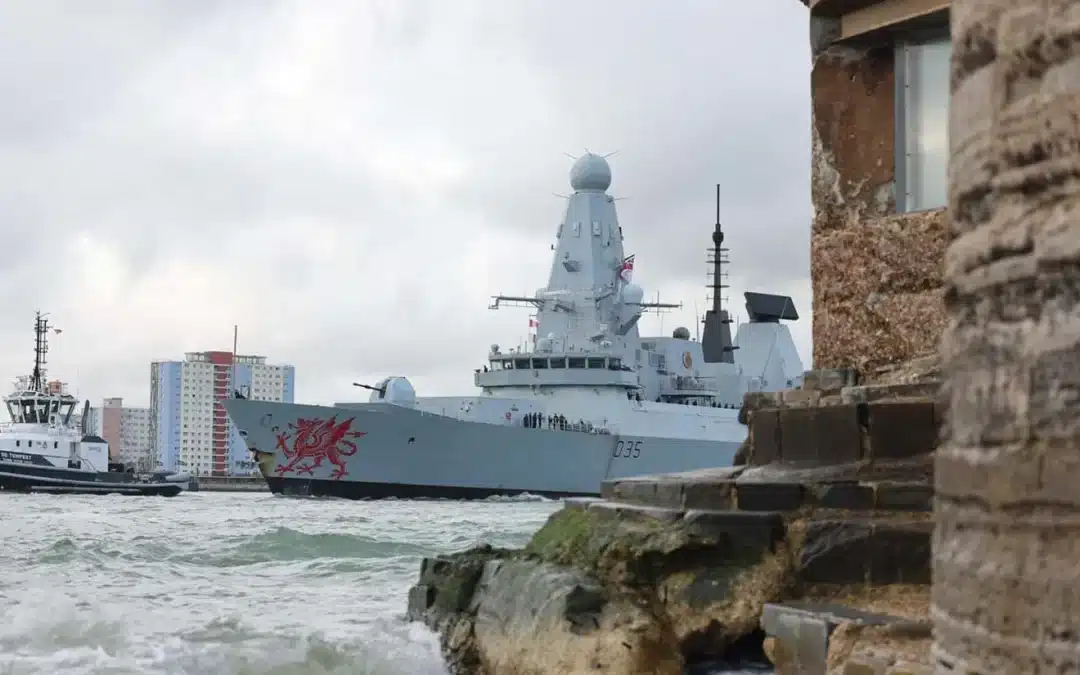
Credit: Royal Navy
Royal Navy destroyer HMS Dragon has departed the UK to head to the Eastern Mediterranean to bolster British defences in the region.
The crew’s loved ones joined hundreds of well-wishers lining the seawall as Dragon slipped out of Portsmouth Harbour, while last week drone-busting Wildcat helicopters departed from RNAS Yeovilton, and on Monday a Merlin Mk2 helicopter from RNAS Culdrose in Cornwall arrived in Cyprus.
The Portsmouth-based warship will use her Sea Viper missile system to help safeguard UK assets and interests – assisted by Wildcats from 815 Naval Air Squadron equipped with Martlet missiles able to deal with the aerial drone threat.
The decision to send the Royal Navy assets came as Iran’s attacks continue to target British interests in the region and the UK Armed Forces continue to adapt to the changing threats.
It builds on the UK increased defensive presence in the region in recent weeks, including deploying radar systems, air defence, and F-35 stealth fighters which are already conducting air defence sorties.
Fleet Commander Vice-Admiral Steve Moorhouse said: “I am proud that our highly-professional personnel have responded in a short time to ensure HMS Dragon and the Wildcats from 815 Naval Air Squadron are fully prepared for their mission.”
Based in Portsmouth and each with a crew of around 200 sailors, the Royal Navy’s six Type 45 destroyers are the Fleet’s first line of defence against aerial threats – aircraft, missiles, drones – and are capable of protecting an area up to five times the size of Cyprus.
HMS Dragon can track hundreds of targets simultaneously – and eliminate them with the Sea Viper system which can launch eight missiles in under ten seconds and direct up to 16 missiles on to their targets simultaneously, closing in for the kill at up to four times the speed of sound, manoeuvring at G-Forces no human can endure.
The system – and the highly-skilled men and women operating it – proved itself time and again in the Red Sea when HMS Diamond repeatedly downed drones and at least one missile launched at passing shipping by Houthi rebels.
Last year Dragon herself became the first British warship to destroy a missile travelling at supersonic speed during an international exercise off Scotland, obliterating the target despite its attempts to corkscrew and weave to avoid Sea Viper.
HMS Dragon’s Commanding Officer, Commander Iain Giffin, said: “My ship’s company have worked tirelessly to ensure we are ready for our mission to the Eastern Mediterranean.
“I am proud of professional manner in which they have responded. We are trained for this, we are ready for this, we have the equipment and people, we have the support of the British people and, most importantly, our families and friends.”
Defence Secretary John Healey MP said: “I have only praise for our Royal Navy personnel and civilian teams who have worked flat out to prepare HMS Dragon for deployment to the Eastern Mediterranean.
“What is normally six weeks of work was completed in just six days – a remarkable effort delivered around the clock. They are the very best of Britain in action.”